
Scott Alexander, one of America’s most influential liberal commentators, confirmed my accusation that liberalism is exhausted.
On July 9, I tweeted:
“We are unfathomably richer than our ancestors. Output per capita in America today is on the order of 900 times greater than before the invention of agriculture, about ~225 times higher than in 1 CE, and about the same (225 times) higher than Europe in 1000 CE.
If measurable productivity were really the greatest object of human society, then we shouldn’t just be a little bit happier than people in the distant (or even recent!) past—we should be *ecstatic*. We should *already* be living in a utopian age of overwhelming contentment. We should be *currently* experiencing a kind of paradise.
The Kingdom of Heaven, as liberalism conceives of it, has already been made real on Earth. We are living in their Eden, and 20% of people are depressed. We’ve stopped reproducing ourselves. We’re overwhelmingly dissatisfied with our governments, anxious about our economies, and pessimistic about the future.”
12 days later, Alexander replied with a defense of growth as the all-consuming intervention that should leave liberals assured their path is leading us, unerring, into future utopia.
He accepted my charge that liberalism is primarily concerned with turning up the dial on the Output Machine. (This surprised me: I worried that I had unfairly stereotyped liberals as mere growth-maximizers; maybe I’d overlooked a still-vibrant reverence for self-government and popular agency.) But we part ways on whether the Output Machine can really deliver happiness.
Even if growth does produce happiness, the magnitude of the effect is narrower than Alexander lets on. And there’s good reason to doubt the effect is a causal one in the first place. His response to my post was exactly as narrow as I’d feared liberalism had become: growth really is what matters, and everyone just needs to keep the faith.
In his view and mine, today’s liberal project balances on a single leg: maximizing productivity. The question, then, is whether this leg can actually bear the weight liberal thinkers have heaped upon it. Alexander’s own evidence shows it’s buckling under that burden.
First, even if we stipulate to his empirical arguments about happiness scaling with income, a myopic fixation on growth is unsupported. Redistribution, too, is an incredibly high-value intervention, with a much shorter timeline to impact than growth-maximizing. Income is only one constitutive element of human well-being among many.
Liberal economists agree: income doesn’t buy much happiness
The crux of Alexander’s empirical argument (what he described as “an elegant mathematical response which will satisfy nobody”) is that happiness scales linearly to the logarithm of income, not to nominal income. Put in simpler terms, the happiness-difference between incomes of $10k and $20k is much larger than the same $10k difference between $500k and $510k, because the happiness effect is proportional as we go up the ladder. This is well-supported, and it makes intuitive sense besides.
The first study he cites, from Matthew Killingsworth, puts the linear correlation between log(income) and happiness at 0.98-0.99. Very convincing stuff. We can see the relevant chart here:
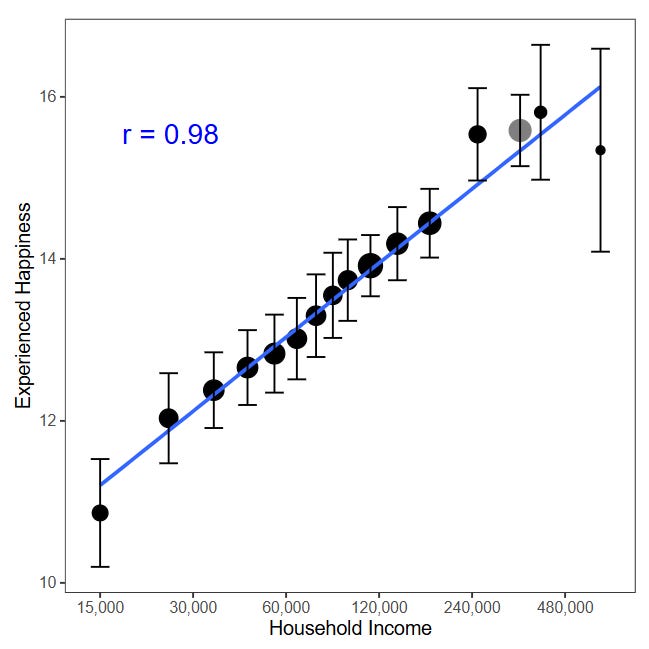
This is absolutely a robust finding. Pay attention to the y-axis, though. Killingsworth used a -50 to +50 scale, so the magnitude of the happiness variance explained by income in this paper amounts to about 5 points on a 100-point scale (from an average value of ~11 to ~16, eyeballing this). In other words, the wealth of a group of people explains about 5% of their happiness.
It’s a small effect. So how does Killingsworth manage to get such a strong correlation? Well, by binning individual responses into income quantiles. As he puts it: “this averages out the substantial variation in individual happiness that income cannot explain, and isolates the underlying shape of the association between income and happiness.” (Emphasis mine.)
In short, a correlation does exist, and it’s plausibly causal. But it’s pretty small.
How small? Well, Alexander cites another article from Killingsworth that gives us the correlation across the entire dataset of individual observations, not just across these smoothed-out groups: “the correlation between average happiness and log(income) is 0.09 in the experience sampling data...the effect of an approximately fourfold difference in income is about equal to the effect of being a caregiver...and less than a third as large as the effect of a headache.” (Emphasis added).
So, according to Alexander’s strongest sources, quadrupling one’s income from $50,000 to $200,000 explains less impact on your happiness any given day than a bad hangover. This is not a suitable foundation on which to build an entire political program--or even most of one.
Why didn’t he deal with the smallness of the income effect in his post? I don’t know, but he may have misinterpreted my original tweet as saying income doesn’t matter at all, in which case this data functions as an effective rebuttal. If that’s what happened, I don’t begrudge Alexander for it; Twitter context-collapse comes for us all.
But my argument was not that growth is irrelevant; merely not so overwhelmingly important that liberals can afford to pay it special attention above everything else. As I wrote in my tweet, “I don’t believe things were better in the poor old days.” But “delivering human contentment is not as simple as turning the dial up or down on the Output Machine,” and “meaning, security, and satisfaction are actually hard problems that demand specific and well-evidenced answers.”
Liberals’ reluctance to tackle other big challenges is evidence of their intellectual exhaustion. And voters penalize them for it. So growth-obsessed liberals often develop feelings of indifference and disdain toward democracy itself. Voters, they conclude, just don’t know what’s good for them.
And, beyond the magnitude of the effect (or lack thereof), there are still more problems for liberals’ obsession with the Output Machine!
Remember, happiness scaling with log(income) rather than with income means that each marginal dollar of income procures less happiness than the last. This means that giving an amount of money to poor people (like through redistribution) improves happiness a lot more than if the same amount went to richer people.
Killingsworth says this himself: “decision-makers that seek to improve collective happiness might find that preferentially increasing incomes of those who earn the least generates a large ROI for collective happiness.”
This study finds an extremely robust income-happiness correlation, and yet redistribution emerges as an essential policy concern, distinct from growth. Clearly, if our ends are maximizing happiness, Alexander’s monomaniacal focus on output is misguided. People can—and should—prefer certain redistributive tradeoffs even if they have negative effects on growth. Alexander anticipates this response to some extent, but handwaves it away in his discussion of an international dataset.
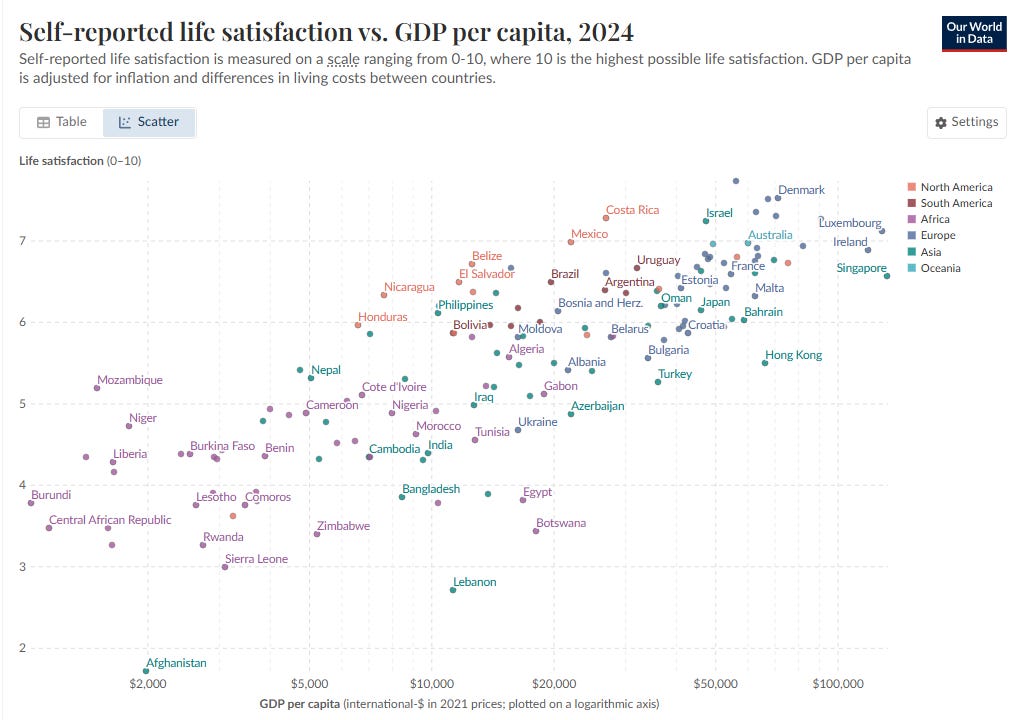
Here, he admits there is significant variation within income bands: the r2 on the whole dataset is about 0.62). But he slightly undersells the variation: “all of the great policies...in Finland/Israel/etc can only buy 0.5 - 1 extra point [of happiness] over the countries that screw them up or pursue the exact opposite policies,” but neither the characterization of the data nor the conclusion he draws are quite right.
Right off the bat, he compared Finland and Israel against the USA—this elides how big the differences can be between the countries that get policies/culture right, and those that “screw them up.” For example, Botswana is slightly richer than Belize, but Belize is 3.27 points higher in life satisfaction. That 3.27 point difference is functionally the same as Alexander’s estimate that, “since the medieval era...happiness should have increased about three points on a 1-10 scale” thanks to economic growth. So even if you buy that growth has bought humans three extra happiness points since 1000 CE, you could apparently get that same boost just by being more like Belize instead of Botswana—today, without waiting a thousand years.
If the happiness gains from non-income factors rival or exceed those from all of modern economic growth, “just focus on growth” is not a serious position.
Not only that, but policy can act much faster than growth can. Alexander pegs the growth benefit at “about one point of extra happiness per century,” but the policy gap between the Nordics and the United States may be similar in size and far more quickly obtainable. A good welfare state is a project achievable in a decade or so, not a century. This, to Alexander, is actually a flaw: “[growth is] stable; no opposite-party administration can take [it] away.” Policy, presumably, is fleeting.
Voters who care about redistribution or “culture” over growth are actually rational actors: a 35-year-old wants to have a happier society at 45 old, not 45 years after they’ve died. There’s nothing immoral or irrational about this kind of time-preference, and liberals would do well to muster some ambitious answers that can happen now, not a century from now.
But Alexander also overstates the extent to which growth is stable, and other policy unstable. For one thing, deep and enduring declines in output are possible even outside of state-collapse scenarios. Greece lost about a quarter of GDP per capita in just five years after the 2008 financial crisis. This wasn’t the result of a civil war, or a revolution, or state collapse. Greece was a relatively high-income liberal democracy that simply cratered due to bad policy and external economic shocks. Growth dividends can be reversed through bad governance, contra Alexander’s “growth is stable” formulation.
Conversely, policy can be durable. Social Security and Medicare have survived decades of hostile-party governments. When you establish a popular redistribution regime in a democratic state, it can be pretty fucking tenacious. The Nordics have also largely retained their ample welfare states; there has been some degradation at the margins, but the core policies remain intact, and people in these countries are the happiest in the world.
So where do we land at the end of this first half of the essay, where I tried stipulating all of Alexander’s evidence? Even if we accept his premises, the answers are clear: income growth has a real effect on happiness, it’s relatively small, it’s not straightforwardly stable, and other policy interventions can work faster to deliver bigger gains—and they’re often quite durable.
These points are simple disagreements over our respective interpretations of the relevant data. But what really alarms me is that Alexander didn’t touch my accusation that liberal frustration has curdled into disdain for democracy. One of liberalism’s greatest contemporary theorists, speaking to an audience that includes much of the Big Tech and AI elite, did not think popular sovereignty worth even a passing mention. The radical project of self-government is liberalism’s greatest legacy—not technocratic fetishism of supply curves.
Instead, he spent 2000 words confessing his exhaustion with everything that isn’t growth. He waved off the effects of “probably culture or something,” dismissed material redistribution as something “opposite-party administration[s] can take...away,” and urged liberals to deepen their worship of the Output Machine: “So long as technological civilization continues to function, we can keep rising and rising, until in 300 years we approach the 10/10 barrier and have to get a new chart.” You won’t get tired of winning, but your great-great-great-grandchildren will.
This is less a political program than it is a belief in some telos of history which Alexander prophesies will vindicate him long after we’ve both passed from the Earth. I don’t know what to call that if not religion. It is, at any rate, a religion with few adherents in America today. If this is the state of liberal ambition, then the center cannot hold.
Growth might not buy any happiness at all
It was worth engaging with a generous interpretation of Alexander’s argument that took his evidence at face-value, but the truth is that his empirical claims are actually fragile. Dissecting them will be the purpose of the second half of this essay.
The biggest problem is simple: all of Alexander’s supporting evidence that growth-over-time increases happiness comes from cross-sectional analysis of societies at one point in time, not time-series data. This is an infamously controversial move, one often criticized by economists in exactly this context. As an example, he makes this claim while comparing Burundi and the USA:
“So if income increased 225x since the medieval era, then using observed coefficients, happiness should have increased about three points on a 1-10 scale. If the average serf would have rated his condition 3/10, we should be at 6/10...
According to the Maddison Project, medieval England c. 1000 AD had a GDP per capita of $1,151. The closest country on this graph is Burundi at $1,031. Asked to rate their happiness on a 1-10 scale, most Burundians say 3 - 4; most Americans say 6 - 7.”
This is what’s called a “space-for-time substitution.” We can’t go back in time to survey medieval English peasants to compare them against modern Americans, so Alexander looks for a group today, in a different place than the USA. He finds modern-day Burundians as a plausible substitute. This kind of move is questionable. It should at least be named and appropriately caveated if you attempt it, but Alexander doesn’t do that.
Anyone can intuit what might be wrong with this swap: Burundians are aware their country is poor relative to the rest of the world. England in 1000 CE was not much poorer than anywhere else—and even if it had been, its peasants would have had little way of knowing.
More importantly, a country at the very bottom of the global income distribution likely has compounding problems that explain its poverty. A country with dysfunctional institutions might be unhappy for reasons unrelated to income. In fact, that dysfunction may be the common cause of both low income and low happiness. Therefore, treating modern Burundi (an extreme low-income outlier) as a valid substitute for medieval England (economically unremarkable in 1000 CE) warrants a high degree of baseline skepticism.
The fact that national happiness correlates far more strongly with log(income) than with individual happiness (remember, that was a correlation of just 0.09, or ~1% of the variance in individual happiness) supports this story about institutions as a common cause of both income and happiness. Richer societies tend to have stronger democracies, less corruption, more security, rule-of-law, and so on; these are the kinds of institutional differences that make countries rich, according to the institutional model of economic growth (exemplified by economists like Daron Acemoglu). They also, quite probably, make people happier.
Additionally, there are other stand-ins we might use to approximate the happiness of our medieval forebears, besides Burundi. Alexander relegates this to the footnotes of his essay, where he admits that present-day “hunter-gatherers are somewhere between 6 and 8 [on the happiness scale] despite their apparent poverty.” Who is the better proxy for our distant ancestors? Burundians, living in a dysfunctional modern society, or those hunter-gatherers, living in groups thought to closely mimic the social and economic environment that prevailed for the vast majority of the human past?
We have to take this much more seriously than Alexander does. If foraging peoples today are about as happy as wealthy Americans are, and if they represent something like a baseline contentment that predominated for most of human existence, then suddenly that lovely chart of countries’ happiness/GDP looks rather bad—half the world is miserable, and only the richest countries have clawed their way back to what was once a universal human patrimony of modest contentment.
Now, these foraging groups are hard to measure, and the studies are usually pretty small. Maybe they’re not very representative of forager societies across history. That’s probably true. But there’s good reason to believe that ancient foragers might’ve been happier than modern ones. Latter-day foragers have mostly been pushed to the least-desirable land by settled agrarian and then urban societies. They have to work harder to secure less subsistence than many foraging societies would’ve in the distant past. And yet they still appear to be relatively happy!
There’s an underlying evolutionary rationale for why this might be the case; for the vast majority of hominid evolution, we really were stuck in the Malthusian Trap. We couldn’t consistently improve per-capita consumption because we lacked the technology for it. Per-capita growth was effectively nonexistent for millions of years, and incredibly slow from the Neolithic through early modernity.
Therefore, our ancestors who cared more about the allocation of finite resources derived from the natural environment were likely to be more fitness-maximizing than those who prioritized increasing production. It makes sense that we’d be more attuned, neurobiologically, to relative incomes rather than absolute incomes, and more attuned still to non-economic factors like the richness of your social connections, or your physical health.
These are all serious cracks in Alexander’s foundation, but they’re merely logical arguments to be skeptical that his evidence actually reveals causation—a good rebuttal, but not as strong as marshaling our own directly contradictory evidence. Luckily, we have that too.
In fact, there is a long-lived and abundant literature devoted to exactly the problem of whether we can infer that more income causes more happiness over time, or if they’re merely correlated at a given moment in time. I’m not sure why Alexander didn’t engage with any of this literature, but in that failure I see more evidence of liberal exhaustion. It’s an unwillingness to look hard and look thoroughly, instead falling back to defend the easy, familiar answer: just keep juicing the Output Machine.
One study from 2016 puts it this way: “one would therefore have expected economic growth to bring considerable increases in life satisfaction. But in many countries, it has not – the so-called ‘Easterlin paradox’.”
They offer this chart to illustrate their point in four wealthy liberal democracies:
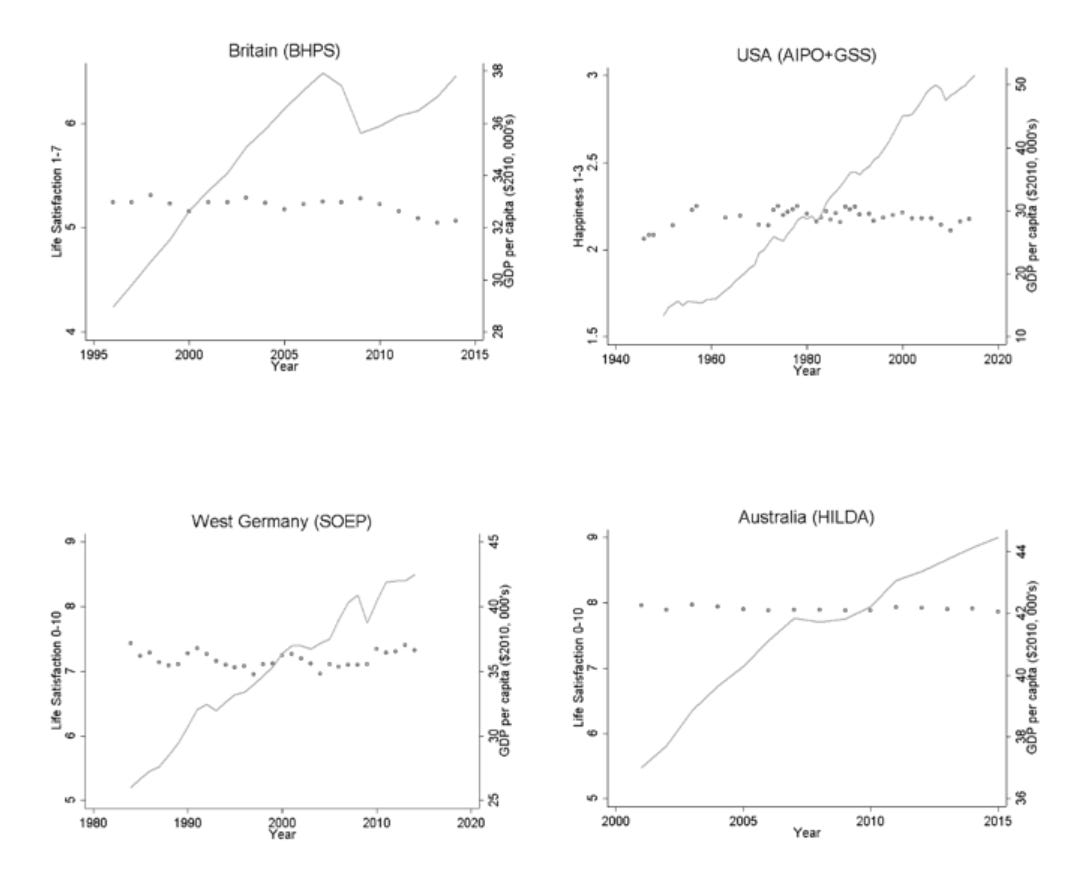
In each of the four countries examined, income rises substantially over time, while observed happiness remains essentially flat. The authors think this has to do with inequality: people “compare their own income to that of their peers.”
The “Easterlin Paradox” mentioned by the authors refers to the observation that log(income) is correlated with happiness, but happiness doesn’t necessarily improve with overall growth. First articulated in the 1970s by economist Richard Easterlin, it directly criticizes Alexander’s premise that cross-sectional analysis of income/happiness can be used to extrapolate how happiness might vary in response to income growth over time.
Notably, in Easterlin’s seminal 1974 paper, he includes a data point on the same happiness scale Alexander uses today. That data point, where the US scored 6.6 out of 10 on the happiness scale, was observed in 1959. American GDP per capita has more than tripled since then, yet life satisfaction scores remain essentially flat.
Alexander admits that America’s “happiness more or less followed a random walk from the beginning of the graph in 1970 to 2020, then suddenly cratered [with the COVID pandemic],” but it’s actually worse than that; we’ve been flat over a 65-year span, not a 50-year one, and over an even bigger multiplier of income that should’ve yielded close to ~0.75 points on the life satisfaction scale.
He dismisses this as the artifact of a temporary shock–COVID–but the Easterlin Paradox was first observed 50 years ago, and the study I quoted earlier was from 2016, before the pandemic. The fact that increasing national incomes don’t necessarily secure more happiness has been evident in the data for a very long time.
Finally, we have the problem of forward expectations. Even if growth plays some causal role in happiness, is that because of the absolute increase in income? Or is it because a consistently growing economy is one in which people have optimistic expectations about their future prospects?
This may sound like hair-splitting, but it matters. If the benefit to happiness comes from absolutely-higher income, then plausibly it might scale infinitely. But if it’s because growth makes people more optimistic about their prospects (like relieving them from worry about losing their jobs), then this may be a fixed benefit that growth secures as long as it’s happening, but which does not compound.
There’s evidence to suggest that exactly these kinds of forward expectations do influence people’s well-being. A 2011 study examining how perceived job insecurity, employability, and actual unemployment affected happiness found that “the potential penalty [to happiness] of unemployment is very large, as other studies have found; however, when circumstances allow a person to have complete confidence in gaining a job the adverse effects of unemployment are more than three quarters mitigated” (emphasis mine).
That’s a huge effect, and it suggests that progressive policies like a national jobs guarantee might yield happiness improvements far in excess of simply raising the incomes of people who would otherwise be unemployed.
Expectations can of course apply to other areas of life besides employment; fears about losing health insurance, losing housing, and inability to afford education all probably yield negative effects on happiness—and could be mitigated with a more robust welfare state that guarantees security in forward expectations.
If I agree strongly with Alexander on anything, it’s that expectations of housing insecurity are surely a drag on American happiness today. Because housing suffers from genuine shortages, we must tweak policy to increase the supply of (especially rental) housing stock. Although I am a socialist, I am nevertheless a YIMBY, and I’m even pretty Abundance-pilled.
How to square that with the pessimistic outlook I’ve taken on the effect that More Output can have on human happiness? Well, housing shortages have effects beyond just eating up people’s disposable incomes; the forward-expectations problem seems massive there.
Becoming homeless (or just having your rent go up) is anxiety-provoking, and this is a happiness-drag even on people who are presently housed. Also, spending money on rents (of all kinds) is subjectively unpleasant.
Plus, a thoughtful abundance program has value beyond merely stoking the Output Machine. I strongly believe that democracy is intrinsically happiness-promoting, and that governments need to be responsive to be truly democratic.
If people vote for a high-speed rail line and it takes 20 years to get built (because of the intolerable proliferation of veto points in our society) then how democratic are we, really? Are we getting the value of agency that democracy brings, and which is itself associated with happiness?
Also, I don’t believe growth is worthless. Yes, Alexander overstated the effects in his own data, drew unsupported conclusions, and didn’t reckon with an extensive literature that rebuts even the small effects on happiness we do observe from log(income). But, even if what really matters for happiness are things like healthy life-years, then a society still needs sufficient productive capacity to devote to, e.g., healthcare.
But I believe that growth, carefully and intentionally directed, can have a bigger impact on human happiness than just letting it rip. That desire for intentional, democratic direction of the economy is precisely why I became a socialist in the first place. Capitalism, I realized, just isn’t that good at maximizing happiness.
Yes, capitalism is fantastic at optimizing productivity and growth. It is world-historically good at producing what people will buy. But the problem is that “what people will buy” isn’t quite the same thing as “what people want,” and “what people want” isn’t the same thing as “what makes people happy.” It turns out that happiness is an extremely hard problem, and there is no One Weird Teleological Trick for solving it.
Alexander disagrees: “our [liberal] plans are measured in centuries; how are the communists’ and fascists’ plans going?” But that is precisely the feeling shared by so many communists and fascists. Across the political spectrum, people are convinced that their program is on an inevitable march to utopia.
Whether you place your faith in the Output Machine, the Material Conditions, or the Volksgeist, these are all ways of soothing the anxiety that comes from acknowledging just how durable human suffering is, and just how monumental the collective task of happiness will be.
I suppose such faith might be happiness-maximizing at the individual level—those forward expectations that are so important to well-being look a lot rosier if you’re convinced you can sit back and let some grand destiny carry your project to inevitable victory. This is one kind of optimization in which I’m uninterested.
Ultimately, I experience my socialist politics as what I can only imagine is karmic punishment for terrible debts in a previous life. Seeing the distance between our time and place, and the socialist future I hope to help build, is excruciating. And we won’t necessarily deliver exceptional happiness and freedom even if we do win a grand struggle for political power!
Everything is contingent, everything must be built, and once built, everything must be defended. Unfortunately, there is no respite from the fight—for anyone, in any time. It is an exhausting thing to acknowledge, but I am not exhausted; I am willing to struggle. I wish more liberals could say the same.
But, regardless, it may well be that the full benefits of liberalism—beyond mere income growth—do actually produce happiness. I’m entirely amenable to the idea that good institutions are the real cause; those institutions make us both richer and happier. A common cause that explains both outcomes. The problem is that Alexander’s essay never defends liberalism on the basis of its many virtues besides economic efficiency; he says nothing about equality, popular democracy, or rule-of-law. If liberals want to renew their political project, they’ll need to think more about these institutions and values, and less about simply juicing the Output Machine.
Alexander put it this way: “What’s the point of liberalism, if plausible rates of GDP growth can only buy us about one point of extra happiness per century?
The question answers itself. All of the great policies...in Finland/Israel/etc can only buy 0.5 - 1 extra point [of life satisfaction] over the countries that screw them up or pursue the exact opposite policies. Meanwhile, economic growth has earned us three whole points since medieval times. And these are stable; no opposite-party administration can take them away. So long as technological civilization continues to function, we can keep rising and rising, until in 300 years we approach the 10/10 barrier and have to get a new chart.”
I read this as a fairly explicit endorsement of preferring growth-maximization over redistribution and other interventions, which he suggests are comparatively less “stable,” and will ultimately be swamped in magnitude besides.
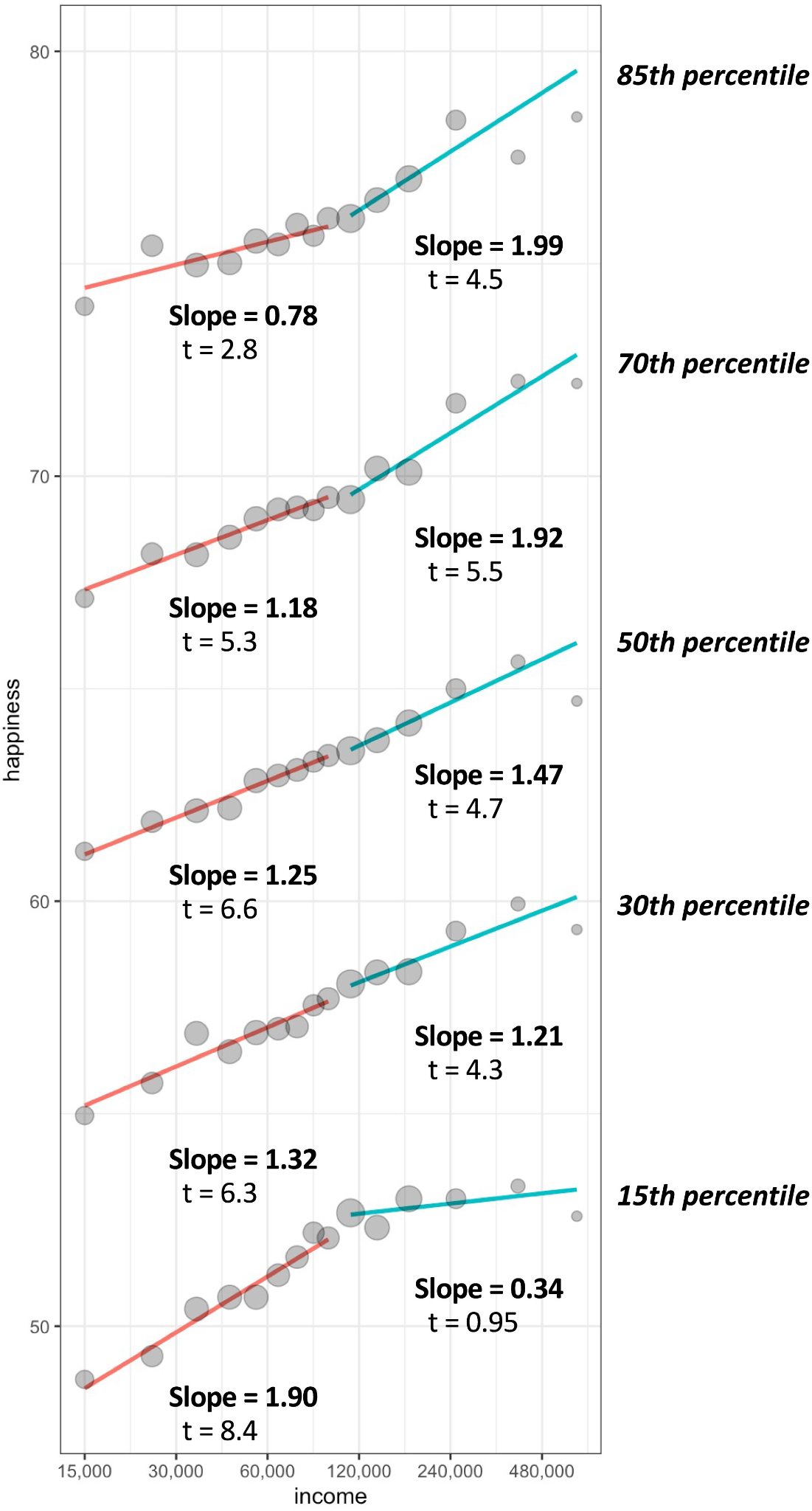
This chart from the second Killingsworth paper provides a visual example of how little happiness income explains, compared to everything else. For people in the lowest income bin, around $15,000, the happiness gap between the 15th percentile of happiness and the 85th percentile is about ~25 points, or five times the amount of happiness explained by variance in income. Even the 30th-percentile-happiest individuals making $15,000 are happier than the 15th-percentile at an income of $480,000! Money can buy happiness, but not all that much--at least not reliably.
The additional finding that the income effect plateaus at the lowest happiness percentiles, while it accelerates at the highest makes some sense--if you’re a happy person with a good life, having money lets you enjoy more of it (go on memory-forming trips with your loving family, play golf at beautiful courses with your healthy body and robust social network, etc). If you’re divorced, insecure, seething, and vindictive--like, say, the richest man in the world--then money can’t do much for you.
It’s worth a minor digression to consider why a headache impacts real-time experiential happiness more than being a caregiver, in Killingworth’s data. A headache is unidirectional—purely negative. You feel worse, no offsetting benefit. Being a caregiver, on the other hand, can provide meaning in your life, but also stress--and the direction and magnitude of the total effect will vary from day-to-day. It also matters who you’re a caregiver for, and why—some relationships between the caregiver and cared-for will be more joyful than others. This logic might suggest something about income, too; some of its effects on life are positive (like more agency), while others are more negative (like less leisure time). For more on the decrease in leisure as income rises (and how this attenuates the apparent effect of log(income) on happiness, see this paper.
It’s worth noting that a 2016 study using a different dataset and different estimation methods from Killingsworth found the same effect size for income on individual happiness. From the authors: “The partial correlation coefficient on income is 0.09, which means that less than 1% of the variance of life satisfaction is explained by income inequality.” Physical health, whether you’re partnered or single, and mental illness diagnoses all register larger effects. Again, not exactly the sort of massive effect that justifies building your entire politics around, while shrugging at other major inputs to human happiness.
From the same international dataset, a non-economic bundle of factors (social support, freedom to make life choices, generosity, and perceptions of corruption) regressed on happiness showed a stronger correlation than log(income)—r2 of 0.68 vs 0.6—but when combined with income, the r2 only improves to 0.74. In other words, of the ~60 percentage points of happiness-variance that income appears to explain on its own, only about 6 are uniquely attributable to income. The other 54 points are shared with variables that correlate with it. This is quite close to Killingsworth’s observation that income explains about 5% of happiness variation between binned groups within the USA. When we look at individuals, income explains about 1% of happiness. At the group level, 5%. In writing this essay, I was surprised how consistently these effect-magnitudes surfaced in different studies by different authors looking at different datasets.
Alexander also says in an aside: “[Finland and Israel] are still within the liberal mainstream, and no country outside the liberal mainstream has ever managed to equal current US happiness levels [of 6.72].” Saying Israel is within the “liberal mainstream” is certainly contestable, but he’s also just wrong. The United Arab Emirates scored slightly higher than the USA in 2024, and I don’t think anyone would reasonably consider them a liberal country. Kuwait hit 6.95 in 2023, Belize a functionally-identical-to-the-US-today 6.71 in 2022, Oman 6.85 in 2019, etc. And he underrates the “near-misses” of countries like Saudi Arabia and Singapore (or Nicaragua, Kosovo, and El Salvador, for that matter). A small miss in a noisy dataset might be considered “equal” if we had error bars to look at.
There are other examples, like Peru’s Lost Decade, or Italy’s stagnation from 2000-2019. And, of course, really bad governance can put you in actual state-collapse territory. I assume Alexander is quarantining those kinds of scenarios from “liberalism,” but I wouldn’t be so sure; in the long arc of history, liberal governments are still vulnerable to catastrophic shocks, revolutions, coups, and civil wars.
It may seem like I’m pushing at edge cases, but the edge cases matter; there is no simple, easy, stable-state you can just fall into where happiness accrues predictably without a fight. Gains in human welfare are, in fact, always hard won and always revocable. When you take the long view, this is an unavoidable truth.
Alexander also tries to quarantine off “media incentives” which “have always leaned towards scaring and outraging people” from the effects of a liberal-capitalist growth paradigm—but the “incentives” he describes are of course profit incentives, and the underlying tech of smartphones and social media are products of free-market growth. That’s how growth actually happens—by constantly introducing new labor-saving technology. But a “maximize growth at all costs” paradigm doesn’t let us examine whether individual technologies are net-beneficial to human well-being, even if they’re efficient places to invest capital. Do any of us really think social media has been a net benefit to human happiness? It’s hard for me to imagine that, and I use it every day.
There is a debate here, of course; I don’t mean to imply Easterlin is uncontested. Stevenson and Wolfers criticized the empirical basis for the paradox in an influential paper in 2008, which Easterlin and his collaborators rebutted in 2010. The paradox-promoting paper I cited in the essay is from 2016, and Easterlin himself is still publishing; the debate goes on, but there is credible reason to believe the really quite small effects of log(income) on happiness, at the level of individuals, do not translate into durable improvements over time with economic growth, and I find these arguments persuasive for both empirical and inferential reasons.
From another Killingsworth paper: “People’s sense of control, measured with the question ‘To what extent do you feel in control of your life?,’ was able to account for 74% of the association between income and experienced well-being.” I’m making my own extrapolation that this sense of agency/control can be obtained, at least in part, through responsive government—but I really do believe that. There are some things that will always be beyond any individual’s control, and yet which have profound effects on our lives; government is the main tool by which we exercise agency in these situations, and so government must be genuinely democratic and responsive for people to feel a sense of control.
Happy to see you writing more long-form! Also also, agree with you on many things and disagree on many things but I'll stick to one: the "durable" policies that you're talking about are insurance, not redistribution.
You only get anything out of social security if you paid into it, and what you get (in SS benefits) is increasing in what you put in. The rich get a smaller fraction back, but they also live longer which offsets this somewhat.
Similarly, unemployment insurance is even more proportional e.g. Danish unemployment benefits are 90% of your income, which means richer people get more. It's mildly redistributive because it's funded by a somewhat progressive tax system & richer people are also less likely to be unemployed, but it's not tax-and-transfer.
Both of these are best thought of as insurance (SS against poverty in old age) which private markets cannot provide due to selection effects e.g. people who are unlikely to be fired will opt out of unemployment insurance, raising the price, causjng more people to opt out until UI is no longer viable. Medicare is literally insurance.
So yes, social insurance is durable, but things like SNAP or Medicare or the EITC are a lot more precarious, as we saw last winter when SNAP benefits were suspended during budget negotiations.
I don't think this undermines this essays claims, but "social insurance is not public aid" is a pet bugbear of mine.
Hi Cassie, thanks for the excellent and insightful piece! I'm sorry my comment is so rambling; your piece sparked a lot of questions that I'm still trying to sort through and I ended up writing a lot more than I intended to.
I think your reasoning and evidence are sound and I agree with much of your argument. In particular, I agree that because of the diminishing marginal return to wealth, redistribution to poor peole is more important than growth for increasing happiness at least in the short- to medium-term (perhaps poorly-designed taxes would sufficiently harm the sort of growth that lifts all boats that it would end up backfiring, but this timescale is probably on the order of decades? And EA/USAID style transfers to the world's poorest people rather than just within one's own country is vastly more effective for increasing global human happiness than continuing growth in a wealthy country of course, but it might be a tough sell getting voters to be ok with scaling this up?) I definitely think happiness being proportional to log wealth is both very plausibly true and is a compelling reason to increase redistribution policies.
However, I think the real value of liberalism is not that it's really good at promoting economic growth, but because it leaves people free to pursue their own vision for "the good life", and focusing on promoting economic growth is conducive to this. For example, illiberal states run competently (such as Singapore, or arguably China etc?) can grow their economies similarly well to liberal states. However, illiberal states impose their vision of "the good life" on their citizens, which can benefit some people but will likely harm others. For example, I imagine that you would be much happier in a relatively liberal country whose government follows a "live and let live" philosophy than living under a theocratic state which considers being transgender to be harmful to human flourishing and therefore prioritizes paternalistically banning living a transgender lifestyle in order to "help" their citizens live happier lives. (Of course, the US both historically and currently does a poor job of protecting transgender people, but I'm sure the US still does better on this score than most/all dictatorships today?) Thus in my opinion, the value of liberal states focusing on economic growth comes from two things: 1. no matter what lifestyle or values you want to pursue, it's easier to do so if you have more wealth, and 2. a state focused on enabling economic growth limits itself to avoid paternalistically and morally intervening in personal affairs.
I realize now that this sounds a lot like arguing for a very laissez-faire libertarianism, which I don't intend. I definitely think that liberal states should intervene in plenty of areas besides for economic growth to promote flourishing, ideally areas that minimally impose worldviews or ideologies on its citizens? (e.g. promoting public health for citizens such as through providing vaccines to everyone is pretty obviously good, though this wouldn't harm the economy at all, and I guess Jehovah's Witnesses or Christian Scientists or whatever would disagree. Or perhaps preserving a clean nature environment by reducing pollution to enjoy is a better example, since it's less ideologically controversial but would require a higher economic sacrifice than vaccines?) Or maybe a better argument would be that the benefit of liberalism is from the strength and quality of its institutions (AJR style) or of having democracy or something, which provide the rule of law and freedoms and so on which facilitate both higher/more consistent economic growth and living a fulfilling life outside of increased wealth? Perhaps I'm making a mistake and misreading your work by conflating (neo)liberalism as economic policy with liberalism as a philosophy/ideology of government in general?
I think someone in the Argument (maybe Jeremiah Johnson, Kelsey Piper, or Noah Smith?) wrote a piece that explains my view on this aspect of liberalism better than I did. I guess I'd conclude by saying that I definitely agree with you that some sort of fusion of Abundance/YIMBY + democratic socialism directing the economic growth of capitalism towards pro-social ends (such as building more housing!) is better for increasing happiness than just hoping laissez-faire capitalism trickles down to everyone and that just increasing wealth is the best way to improve social conditions, but that I'm wary of looking for government to provide meaning and values in life beyond facilitating economic growth (and of course providing useful public goods). I'm also very wary of unleashing populist policy as a way to help people "feel in control of their lives" as I strongly feel that many aspects of government are better off in the hands of experts than being controlled by popular vote of an uninformed electorate (for example, I strongly prefer having Fauci run the CDC over RFK and having Powell run the Federal Reserve over Trump, and if health and macroeconomic policy were more "responsive" to voters, it would look more like what Trump and RFK are doing than under more trustworthy and competent leadership). But I still strongly agree that government should be democratic and responsive; perhaps there are certain aspects of government that should be controlled by qualified elites/institutions but most areas should be more democratic, but that's another long comment and I'm not sure how to reconcile my love of democracy with my fear of populism.
Anyways, thanks for the excellent article, and I hope Scott Alexander gives you a thoughtful reply!